
Imagine walking into a room and discovering that the floor itself is watching you.
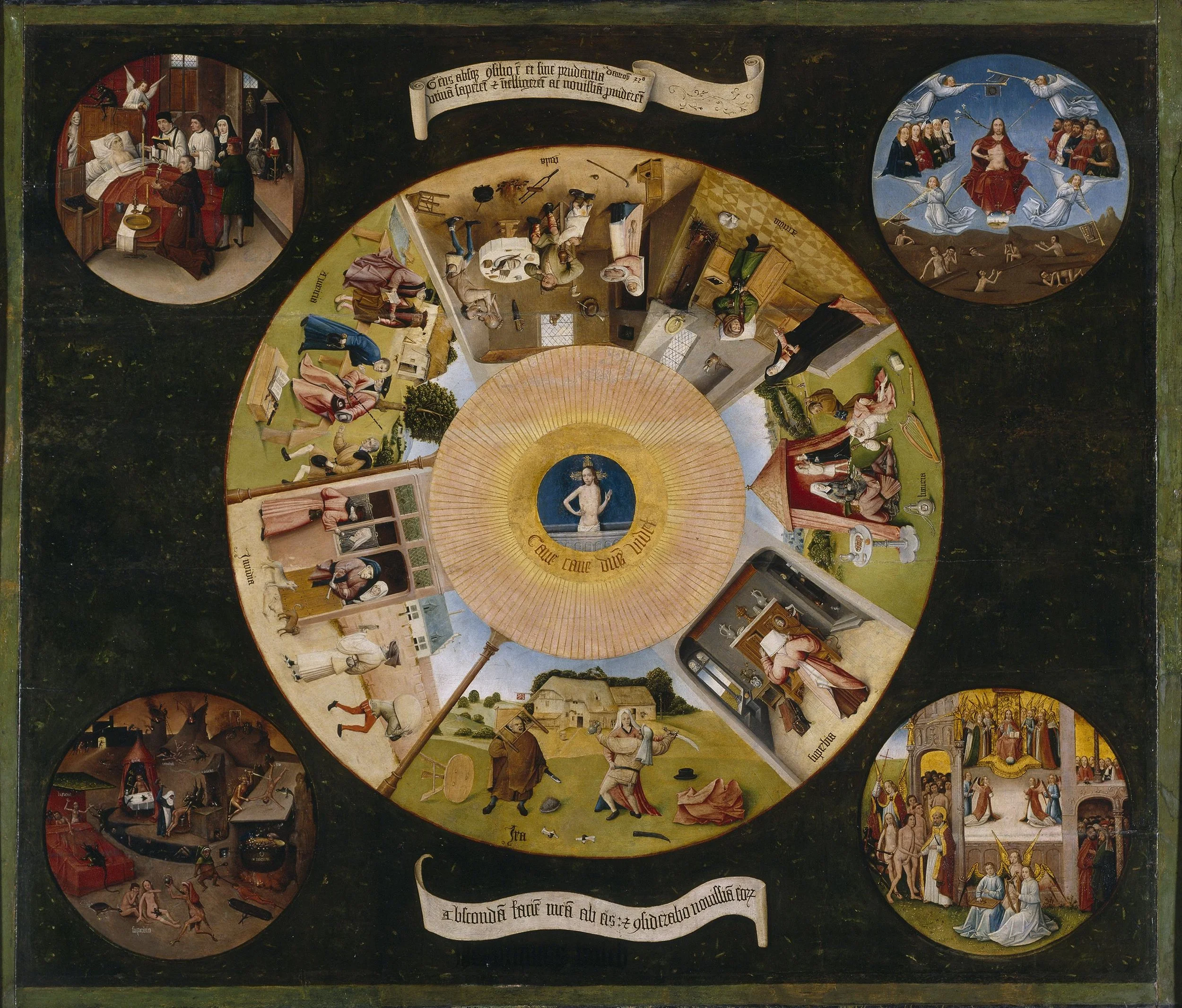
That is the remarkable experience Hieronymus Bosch intended with The Seven Deadly Sins and the Four Last Things, painted around 1480–1485. Unlike his famous triptychs, this work is a single circular composition designed to confront viewers with an uncomfortable truth: every action, no matter how private, is seen by God.
Part moral lesson, part devotional aid, and part artistic masterpiece, the painting reveals a young Bosch already mastering the symbolism and storytelling that would later make him one of history's most original artists.
A Painting Unlike Any Other
At first glance, the painting resembles an enormous human eye.
At its centre stands the risen Christ emerging from His tomb, displaying the wounds of the Crucifixion. Around Him appears the Latin inscription:
"Cave, cave, Dominus videt."
Translated, it means:
"Beware, beware, the Lord sees."
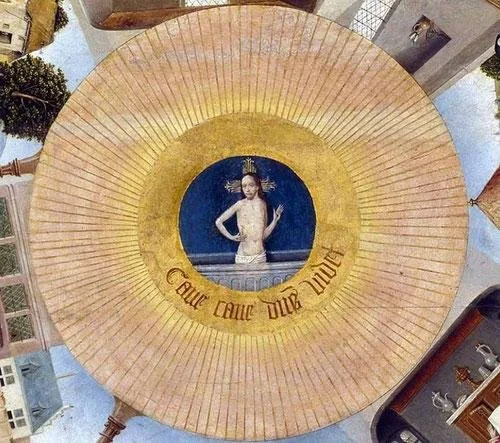
This central "Eye of God" forms the heart of the composition. Surrounding it are seven wedge-shaped scenes, each illustrating one of the Seven Deadly Sins that medieval Christians believed led people away from God.
In the four corners of the panel are additional scenes representing the Four Last Things—Death, Judgment, Heaven, and Hell—the ultimate destiny awaiting every soul.
The result is both beautiful and unsettling, encouraging viewers to examine not only the painting but also themselves.
The Seven Deadly Sins
Rather than depicting dramatic biblical events, Bosch places each sin within ordinary life.
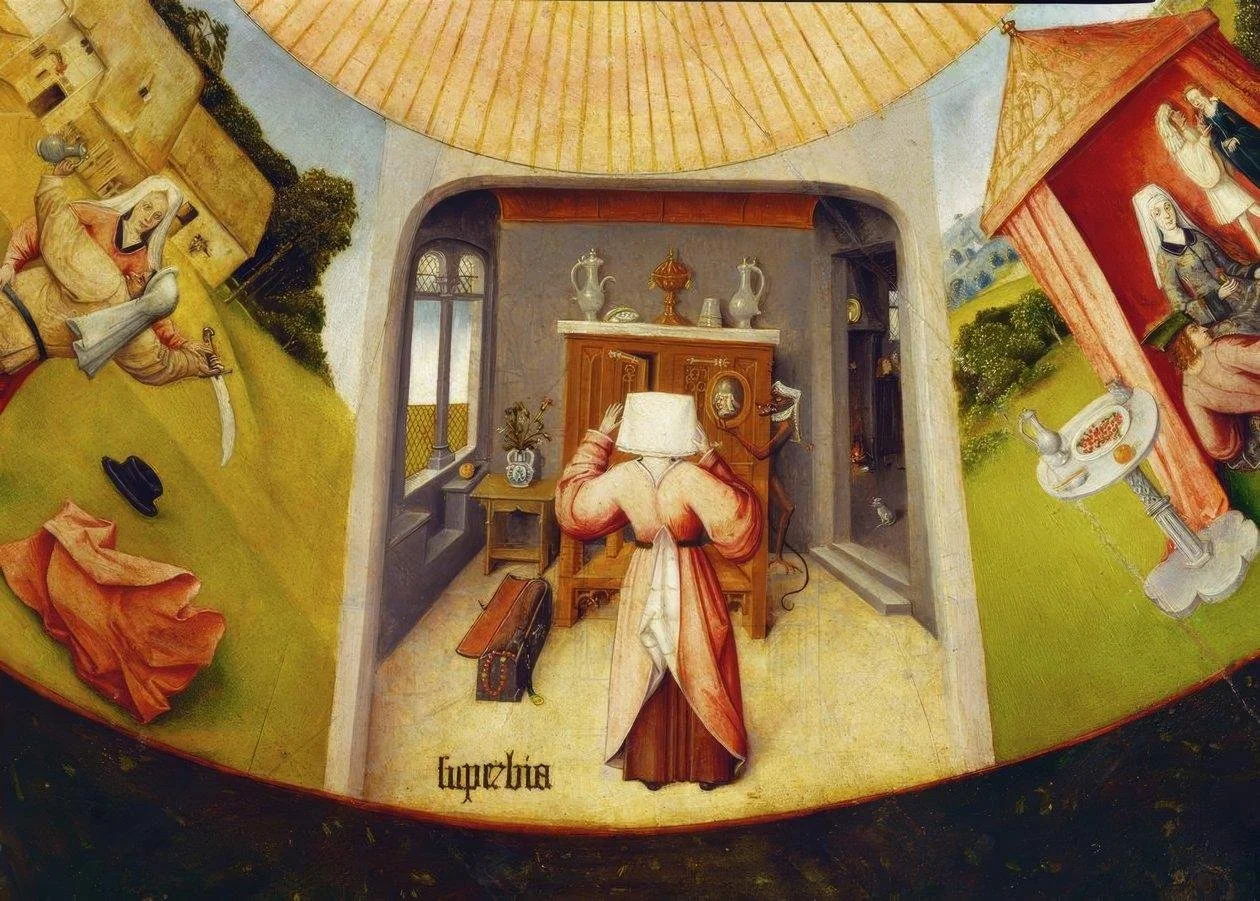
Pride
A wealthy woman admires herself in a mirror held by a demon disguised as a servant. Vanity blinds her to the spiritual danger standing beside her.
Greed
A corrupt judge accepts gifts while pretending to administer justice. Wealth has replaced fairness.
Lust
Elegant couples gather beneath a tent for music, conversation, and flirtation. What begins as innocent pleasure gradually becomes moral temptation.
Envy
Neighbours resent each other's success while animals fight over scraps, reflecting the destructive nature of jealousy.
Gluttony
An overweight man indulges in excessive food and drink while ignoring moderation.
Wrath
Two men settle a disagreement with violence instead of reason, reminding viewers that uncontrolled anger destroys both victim and aggressor.
Sloth
A comfortably seated man sleeps while neglecting his spiritual responsibilities, illustrating that laziness can be as dangerous as more obvious sins.
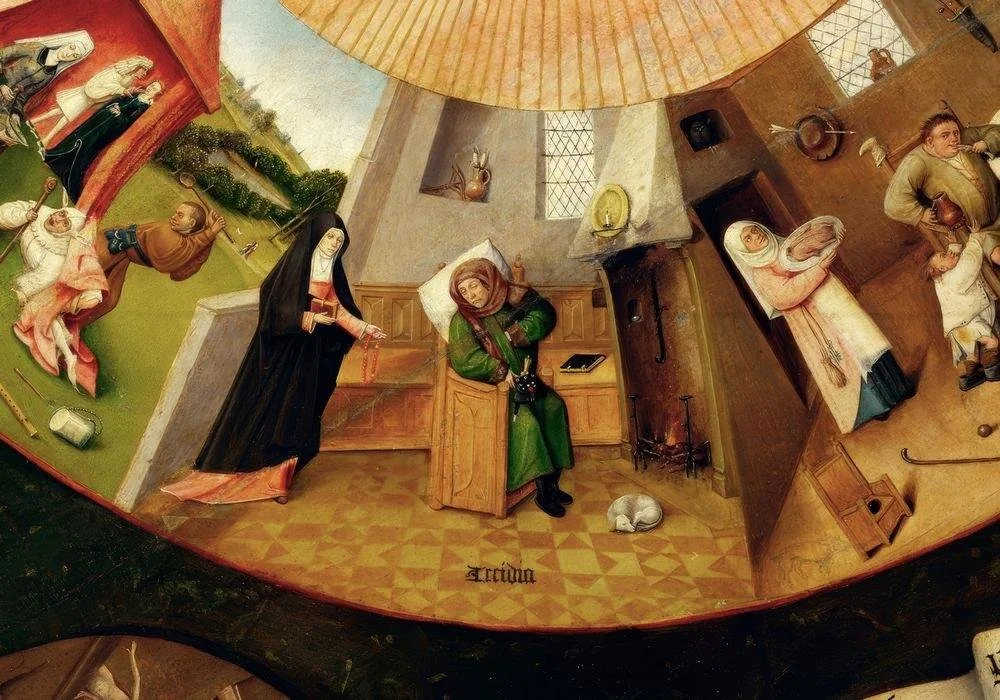
Each scene appears almost humorous at first, yet Bosch's message remains serious.
Sin rarely begins with dramatic evil.
It begins with ordinary choices.
The Four Last Things
In the corners, Bosch reminds viewers where those choices ultimately lead.
Death shows humanity's inevitable end.
The Last Judgment depicts Christ judging every soul.
Heaven welcomes the righteous into eternal joy.
Hell presents terrifying punishment for those who reject God's path.
Together, these scenes frame everyday life within the larger story of eternity.
Who Commissioned the Painting?
Surprisingly, no one knows for certain.
Unlike some of Bosch's later works, there is no surviving contract or payment record identifying the original patron.
One long-standing tradition claims that King Philip II of Spain, a great admirer and collector of Bosch's paintings, believed the work had belonged to Philip the Handsome (Philip I of Castile). However, there is no documentary evidence proving this ownership, and modern scholars regard the claim as uncertain.
Some historians believe the panel may have been commissioned by a wealthy private patron for use in a domestic setting rather than a church. Its relatively modest size and moral subject matter suggest it may have served as a devotional object intended to encourage daily reflection.
Another intriguing theory proposes that the painting functioned as a tabletop. Although it is now displayed vertically in Madrid's Prado Museum, its circular design would have worked equally well when viewed from above, allowing guests gathered around the table to contemplate the Eye of God looking upward at them.
Whether hung on a wall or placed on a table, its purpose remained the same:
To remind viewers that every action has consequences.
Europe Around 1485
Bosch painted during a period of prosperity and uncertainty.
The Burgundian Netherlands ranked among Europe's wealthiest regions, with thriving cities connected by trade routes stretching from England to Italy. Merchants accumulated fortunes, universities expanded learning, and artists refined the new possibilities of oil painting.
Yet beneath this prosperity lay deep religious concern.
The Church emphasized confession, repentance, and preparation for death. Books known as Ars Moriendi ("The Art of Dying") taught Christians how to prepare for their final moments, while sermons frequently reminded congregations that earthly success meant little without spiritual readiness.
Bosch absorbed this worldview completely.
Rather than portraying distant biblical history, he showed contemporary men and women making everyday choices that carried eternal significance.
Bosch's Growing Artistic Vision
Although painted relatively early in his career, The Seven Deadly Sins and the Four Last Things introduces many ideas that would define Bosch's greatest masterpieces.
Like The Conjurer, it explores human weakness through ordinary life rather than fantastic monsters.
Like Ecce Homo, it asks viewers to examine their own moral choices instead of judging others.
And like The Garden of Earthly Delights, it presents humanity as standing between temptation and salvation.
Bosch's extraordinary gift was his ability to transform familiar scenes into profound moral reflections.
A Painting That Still Speaks Today
More than five hundred years later, Bosch's warnings remain surprisingly relevant.
Pride can be found in social media obsession.
Greed appears in corruption and exploitation.
Envy thrives in constant comparison.
Gluttony extends beyond food to endless consumption.
Wrath spreads through outrage and division.
Sloth becomes indifference to injustice.
Lust reduces people to objects.
Bosch understood something timeless about human nature:
Technology changes.
Human hearts change very little.