
Few paintings capture the tension between wealth, mortality, and salvation as vividly as Hieronymus Bosch's Death and the Miser. Unlike many medieval depictions of death, Bosch's painting is not simply about dying—it is about the choices we make in our final moments and whether a lifetime of greed can be overcome by a last act of repentance.
Painted around 1490–1495, this haunting work is filled with symbolic details that reward close examination. Every object, every figure, and even the direction in which the miser looks tells part of the story.
A Room Filled with Temptation
At first glance, the scene appears straightforward. An elderly man lies in bed while Death enters the room carrying an arrow. Time has run out.
Yet the room is anything but ordinary.
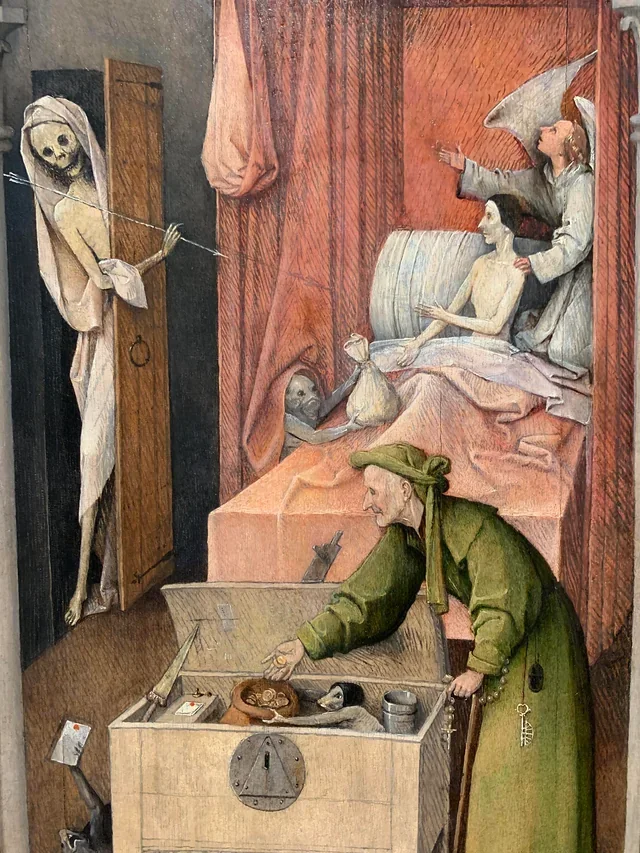
The dying man is surrounded by symbols of wealth: coins spill from chests, expensive clothing hangs nearby, and money dominates the composition. Bosch transforms the bedroom into a spiritual battlefield where the miser must choose between earthly riches and eternal salvation.
Unlike modern depictions of death as peaceful or inevitable, Bosch presents the moment as one of active moral decision.
The Angel and the Demon
One of the painting's most striking features is the contrast between the angel and the demon.
A small angel kneels beside the dying man, gently encouraging him to look toward the crucifix visible through the open window. The crucifix is bathed in light, representing Christ's offer of redemption.
On the opposite side, however, a grotesque demon tempts him with a bag overflowing with gold.
Bosch leaves the outcome deliberately uncertain.
The miser reaches toward the money, yet his gaze also drifts toward the light outside. The viewer is left wondering which desire will ultimately prevail.
This ambiguity is part of the painting's enduring power.
Death Is Not the Enemy
Modern audiences often assume the skeleton represents evil, but Bosch's Death is surprisingly neutral.
The skeletal figure calmly enters carrying an arrow, an ancient symbol that life can end instantly and without warning. Death itself is not portrayed as malicious. Instead, it is simply unavoidable.
The true struggle lies within the miser's own heart.
For Bosch, temptation—not death—is humanity's greatest enemy.
The Strange Creatures
As in many of Bosch's works, demons populate the room.
These bizarre hybrid creatures are not random monsters. Medieval viewers would have understood them as visual representations of sins, temptations, and spiritual corruption.
One demon presents gold.
Others lurk in shadows, watching the dying man.
Rather than physically attacking him, they exploit the habits he has cultivated throughout his life. Bosch suggests that our daily choices shape our final moments.
The Earlier Version of the Miser
An intriguing detail often overlooked is the younger version of the miser shown in the foreground.
He is shown stuffing money into a chest while another demon encourages his actions. This is not a second person but a narrative device, illustrating the man's earlier life of greed.
Bosch compresses time into a single image.
The foreground reveals the choices that led to the deathbed scene, emphasizing that final decisions are rooted in habits formed over many years.
Part of a Larger Work?
Many art historians believe Death and the Miser was originally one wing of a larger triptych that has since been dismantled.
Technical studies of the oak panel and stylistic similarities suggest it may once have formed part of a complete moral cycle examining human sin and salvation. Although scholars continue to debate its original arrangement, the painting shares themes with Bosch's other moralizing works such as The Haywain and The Seven Deadly Sins and the Four Last Things.
Its relatively small size may have made it suitable for private devotion rather than display in a church.
Medieval Views on Wealth
The painting reflects widespread late medieval concerns about the spiritual dangers of wealth.
The issue was not that money itself was sinful. Rather, greed—the unwillingness to use wealth wisely or charitably—was considered one of the deadly sins.
Bosch lived during a period of expanding commerce in the Low Countries. Successful merchants accumulated unprecedented fortunes, while religious writers warned that attachment to riches could distract believers from preparing for death.
Death and the Miser visualizes those concerns with extraordinary clarity.
Bosch's Remarkable Storytelling
One reason Bosch remains so compelling is his ability to tell an entire story without words.
The painting unfolds almost like a graphic novel:
The foreground shows the miser's lifelong obsession with wealth.
The center captures his final moments.
The window points toward eternity.
Rather than presenting separate scenes, Bosch layers time and symbolism into a single composition, inviting viewers to linger and uncover new meanings with every viewing.
Where Is Death and the Miser Today?
Today, Death and the Miser is housed in the National Gallery of Art in Washington, D.C., where it remains one of Bosch's most fascinating surviving paintings.
Modern conservation and infrared imaging have revealed underdrawings that demonstrate Bosch's careful planning and occasional revisions during the painting process, offering valuable insight into his creative methods.
More than five centuries later, the work continues to challenge viewers with a timeless question:
When everything else falls away, what truly matters?
Final Thoughts
Death and the Miser is more than a meditation on mortality. It is a painting about priorities.
Bosch reminds us that the habits we cultivate throughout life shape the choices we make when confronted with our own mortality. Wealth, comfort, and possessions may seem permanent, but in the end they cannot accompany us beyond death.
Whether viewed as religious instruction, psychological drama, or a masterpiece of symbolic storytelling, Death and the Miser remains one of Bosch's most powerful and thought-provoking works.