
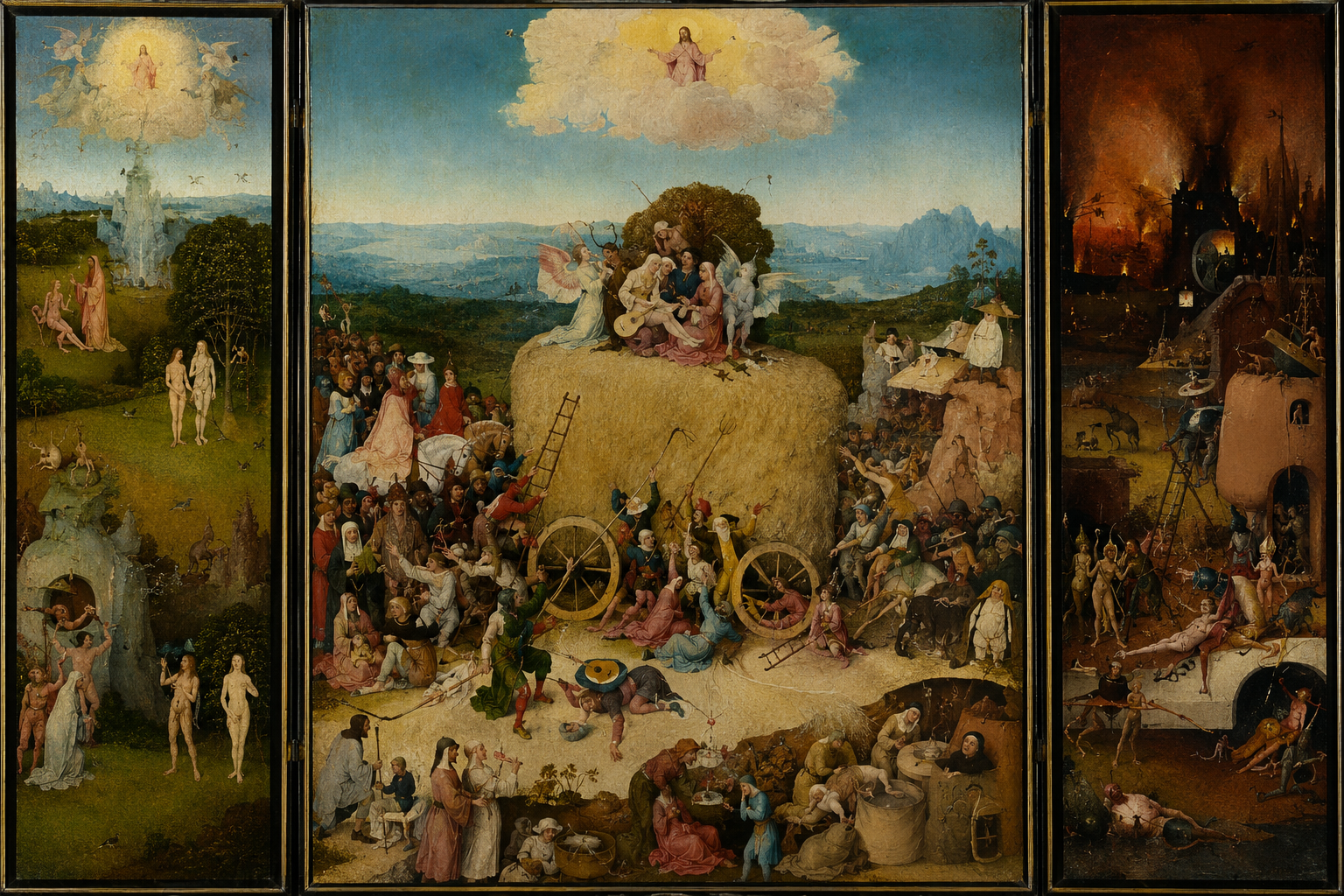
Bosch’s The Haywain Triptych: The World Chasing After Nothing
At first glance, Hieronymus Bosch’s The Haywain Triptych seems almost festive. A great wagon piled impossibly high with golden hay rolls through a crowded landscape. People climb onto it, reach toward it, follow behind it, and fight for whatever pieces they can seize. Musicians play. Lovers embrace. Clergy, nobles, peasants, thieves, and fools all crowd together.

Bosch's Death and the Miser: A Final Choice Between Heaven and Gold
Few paintings capture the tension between wealth, mortality, and salvation as vividly as Hieronymus Bosch's Death and the Miser. Unlike many medieval depictions of death, Bosch's painting is not simply about dying—it is about the choices we make in our final moments and whether a lifetime of greed can be overcome by a last act of repentance.

The Seven Deadly Sins and the Four Last Things: Bosch's Timeless Warning About Human Nature
Imagine walking into a room and discovering that the floor itself is watching you. That is the remarkable experience Hieronymus Bosch intended with The Seven Deadly Sins and the Four Last Things, painted around 1480–1485. Unlike his famous triptychs, this work is a single circular composition designed to confront viewers with an uncomfortable truth: every action, no matter how private, is seen by God.

The Conjurer: Bosch's Clever Warning About Deception
Long before Hieronymus Bosch filled his paintings with fantastical monsters and dreamlike landscapes, he turned his sharp eye toward a more familiar danger: deception. Painted around 1475–1480, The Conjurer is one of Bosch's earliest surviving works and offers a fascinating glimpse into the artist's wit, moral insight, and extraordinary attention to human behavior.

Ecce Homo: Bosch's Earliest Surviving Masterpiece
Before Bosch became famous for the astonishing imagination of The Garden of Earthly Delights, he painted a work that is strikingly restrained. Ecce Homo ("Behold the Man") reveals an artist already fascinated by human nature—not through fantastic monsters, but through ordinary people confronted with extraordinary choices. Painted around 1475–1480, this is one of Bosch's earliest surviving works and offers a glimpse into the foundations of his artistic vision.

What Theatre May Have Influenced Hieronymus Bosch?
hen we look at the fantastical worlds painted by Hieronymus Bosch, it is tempting to imagine that his visions sprang entirely from an extraordinary imagination. The bizarre hybrid creatures, scenes of temptation, and terrifying depictions of Hell seem unlike anything else in Renaissance art. Yet Bosch did not create his masterpieces in isolation. He lived in a vibrant medieval culture where religion, theatre, festivals, music, and public performance blended together to communicate moral lessons.

What Would Marcel Duchamp Think of AI?
If there’s one artist who would feel strangely at home in the age of AI-generated images, it’s Marcel Duchamp. Long before algorithms could remix the visual world, Duchamp was already asking a destabilizing question: What actually makes something art?

The Tools I Used to Create My Graphic Novels
Creating a graphic novel no longer means starting from a blank page. For this project, I combined AI-generated imagery with a set of free, open-source tools: GIMP, Inkscape, and Scribus.
AI helped generate the raw visual material—but these tools are what turned that material into a coherent, readable, print-ready book.

Hieronymus Bosch and the Illustrious Brotherhood of Our Blessed Lady
History leaves us very little of Bosch’s inner life—but his marriage is one of the few places where the record sharpens, even if only slightly. Bosch married Aleid van de Meervenne sometime around 1481. She was not a marginal figure. She came from a well-established, likely wealthy family in ’s-Hertogenbosch, a town that was both commercially active and culturally alive in the late 15th century. Through this marriage, Bosch gained something rare for an artist of his time: stability.

Why Hieronymus Bosch Is Perfect for a Graphic Novel
Bosch does not explain himself. His work resists clarity in a way that feels almost contemporary—crowded with symbols, half-legible narratives, and images that seem to shift meaning the longer you look. In a single panel, a figure might be suffering, transforming, or transcending. You are never given the answer. You are asked to sit with it. That makes him an unusually powerful subject for a graphic novel.

The Marriage of Hieronymus Bosch and Aleid van de Meervenne
History leaves us very little of Bosch’s inner life—but his marriage is one of the few places where the record sharpens, even if only slightly. Bosch married Aleid van de Meervenne sometime around 1481. She was not a marginal figure. She came from a well-established, likely wealthy family in ’s-Hertogenbosch, a town that was both commercially active and culturally alive in the late 15th century. Through this marriage, Bosch gained something rare for an artist of his time: stability.

AI and the Graphic Novel: Process, Possibility and Restraint
There’s a quiet tension at the heart of using AI to create art for a graphic novel. On one hand, it offers speed, flexibility, and access to visual worlds that might otherwise take years to render. On the other, it challenges traditional ideas of authorship, craft and intention. The result isn’t a replacement for the artist—it’s a new kind of collaboration.