
Long before Hieronymus Bosch filled his paintings with fantastical monsters and dreamlike landscapes, he turned his sharp eye toward a more familiar danger: deception. Painted around 1475–1480, The Conjurer is one of Bosch's earliest surviving works and offers a fascinating glimpse into the artist's wit, moral insight, and extraordinary attention to human behavior.
At first glance, the painting appears almost humorous. A street magician entertains a crowd with a simple trick. But look closer, and Bosch reveals that the greatest illusion is not the one performed by the conjurer—it is the one willingly accepted by his audience.
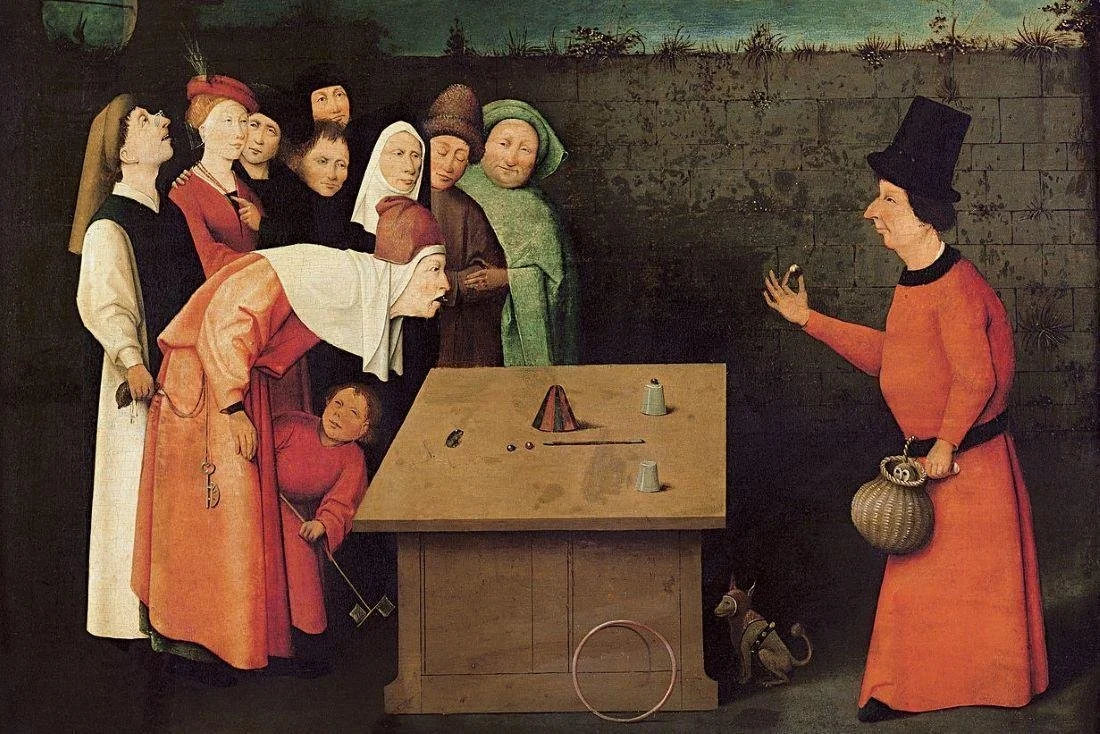
A Street Performance with a Hidden Lesson
The scene unfolds in what appears to be a bustling town square.
At the center stands the conjurer, a travelling entertainer performing the classic cups-and-balls trick, one of the oldest magic illusions in history. His audience watches intently, completely captivated by his movements.
Directly opposite him, a well-dressed man leans forward in amazement, his mouth hanging open as he becomes absorbed in the performance.
Meanwhile, unnoticed by the distracted spectator, a nimble pickpocket quietly removes a purse from his belt.
Bosch invites viewers to notice what the victim cannot.
The real trick is not the magician's sleight of hand—it is the thief's.
A Description of the Painting
Although small in size, The Conjurer is packed with carefully observed details.
The magician wears brightly coloured clothing and performs confidently before an attentive crowd. His table is covered with the tools of his trade: cups, balls, and small objects arranged to keep the audience focused exactly where he wants them to look.

Near the front of the gathering, the unsuspecting victim bends so far forward that he loses awareness of everything around him.
Behind him, the pickpocket calmly slips a money pouch from the man's belt while an accomplice watches nearby.
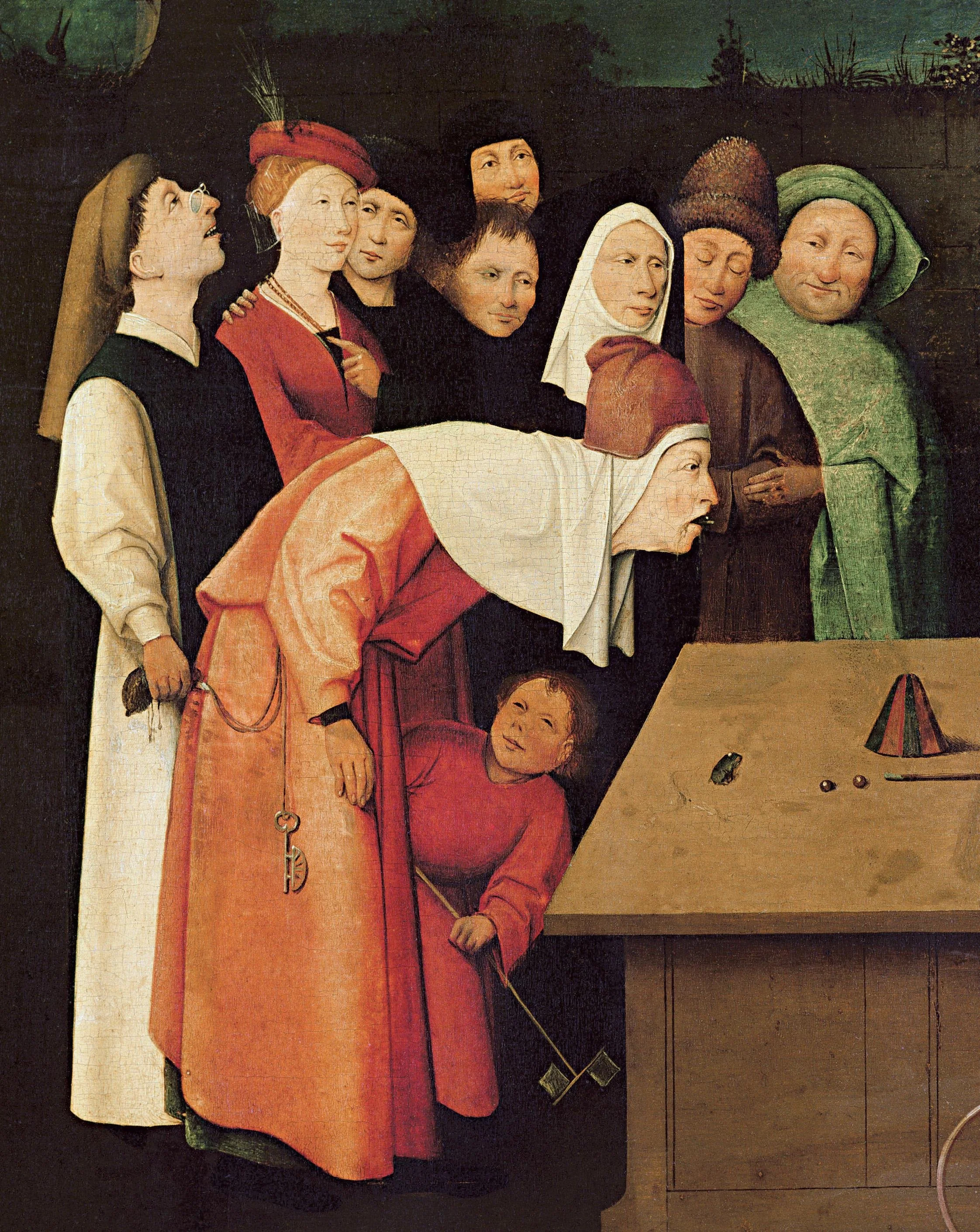
Children, curious onlookers, and ordinary townspeople complete the scene, each reacting differently to the spectacle.
Every figure contributes to Bosch's central message about distraction and misplaced trust.
More Than Entertainment
Modern audiences often see The Conjurer simply as a charming depiction of medieval street life.
For Bosch's contemporaries, however, the message would have been unmistakable.
Street entertainers occupied an uneasy place in late medieval society. Although many were honest performers, others travelled alongside gamblers, fortune tellers, confidence tricksters, and thieves. Religious writers frequently used magicians and jugglers as symbols of deception and spiritual distraction.
Bosch was not condemning entertainment itself.
Instead, he warned against becoming so fascinated by appearances that we fail to notice the dangers around us.
The victim loses his purse because he stops paying attention.
Europe Around 1480
The late fifteenth century was a time of enormous change across Europe.
Trade expanded rapidly as prosperous towns grew throughout the Low Countries. Markets became lively centres where merchants, entertainers, pilgrims, craftsmen, and travellers from across Europe mixed together.
Bosch lived in 's-Hertogenbosch, one of Brabant's thriving commercial cities. On any market day, he would have encountered musicians, acrobats, animal trainers, storytellers, and travelling magicians much like the conjurer in his painting.
At the same time, Europe was undergoing profound intellectual and religious transformation.
The printing press, introduced only a few decades earlier by Johannes Gutenberg, was spreading books and ideas at an unprecedented pace. Renaissance humanism encouraged observation of the natural world, while the Church continued to stress moral vigilance against temptation and deception.
Bosch absorbed both influences. His paintings reward careful observation while reminding viewers that appearances can be dangerously misleading.
Bosch's Emerging Artistic Voice
Although The Conjurer lacks the fantastical creatures that would later make Bosch famous, many hallmarks of his mature style are already visible.
First is his fascination with human psychology. Every character reacts differently to the performance—curiosity, delight, skepticism, greed, and distraction all appear within a single small composition.
Second is Bosch's love of visual storytelling.
The painting unfolds almost like a comic strip. As viewers notice the theft taking place behind the victim, they become active participants in the story rather than passive observers.
Finally, Bosch demonstrates his lifelong interest in moral ambiguity.
The magician may or may not be involved in the theft. Bosch leaves the question deliberately unanswered, encouraging viewers to draw their own conclusions.
A Lesson That Still Feels Modern
More than five centuries later, The Conjurer remains remarkably relevant.
Its warning extends far beyond medieval street performers.
Whether the distraction comes from clever advertising, misinformation, scams, sensational headlines, or persuasive personalities, Bosch reminds us that what captures our attention can also blind us to what truly matters.
The victim does not lose his purse because the thief is especially clever.
He loses it because he is looking in the wrong direction.
Why The Conjurer Matters
Although overshadowed by later masterpieces such as The Garden of Earthly Delights and The Haywain, The Conjurer reveals Bosch developing many of the ideas that would define his entire career.
Rather than relying on monsters or visions of Hell, he exposes ordinary human weakness through an everyday scene that any viewer could recognize.
His message is simple, timeless, and surprisingly contemporary:
The greatest deceptions often succeed because we choose to look somewhere else.