
When people think of Hieronymus Bosch, they usually picture impossible creatures, burning cities, and bizarre visions of Heaven and Hell. Yet one of his earliest known paintings contains none of these fantastical inventions. Instead, it presents a simple biblical scene whose emotional power comes from the expressions of ordinary men and women.
Bosch's Ecce Homo invites us to stand among the crowd gathered before Christ, forcing us to ask a timeless question: How would we have responded?
What does "Ecce Homo" mean?
The title comes from the Latin words spoken by Pontius Pilate in the Gospel of John (19:5):
"Ecce Homo" — "Behold the Man."
After Christ has been scourged and crowned with thorns, Pilate presents Him to the crowd in hopes that they will show mercy. Instead, the crowd demands His crucifixion.
Rather than emphasizing physical suffering, Bosch focuses on the reactions of the people watching.
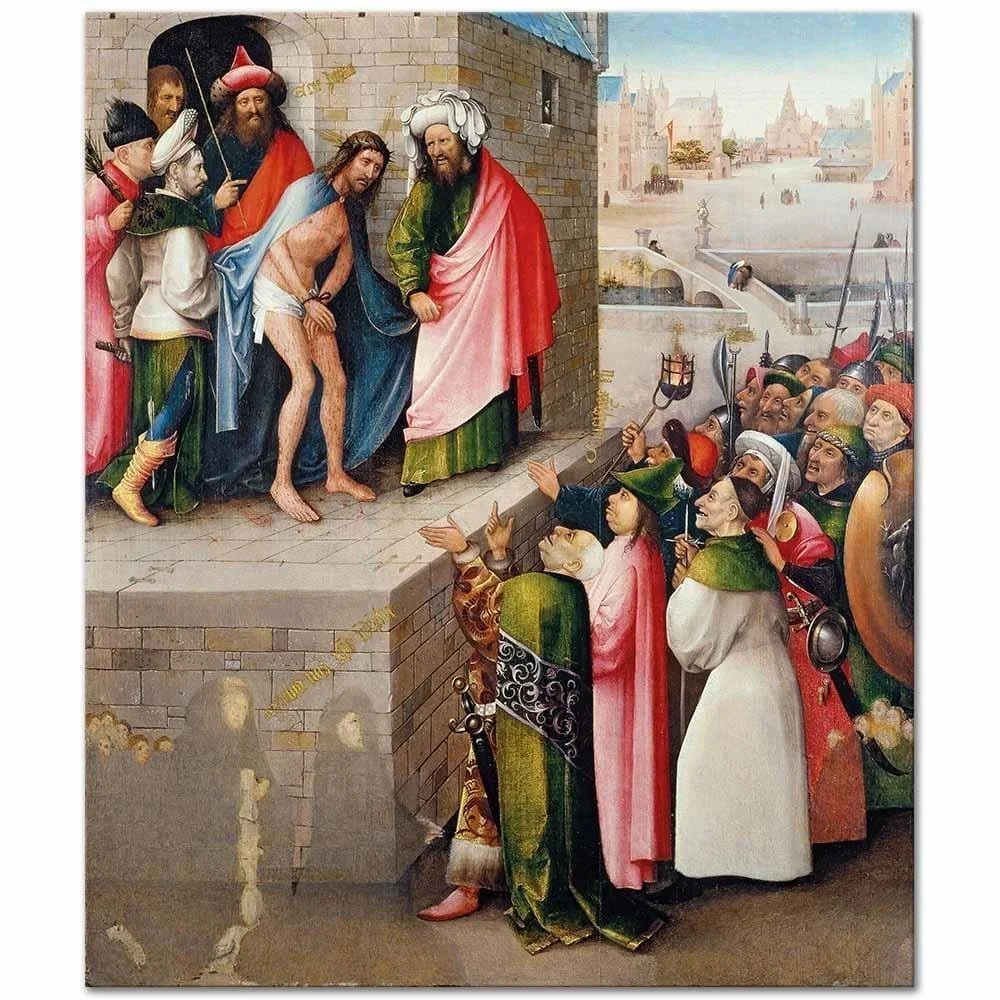
Hieronymus Bosch, Ecce Homo, c. 1475–1480. Oil on oak panel. One of Bosch's earliest surviving paintings depicts Pontius Pilate presenting Christ to the crowd before the Crucifixion.
The Painting
The composition is surprisingly intimate.
Christ stands quietly in the center, wearing the crown of thorns and a purple robe. His hands are bound, yet His posture remains calm and dignified. His face reflects sorrow rather than anger.
Standing beside Him is Pontius Pilate, richly dressed and gesturing toward Christ as if appealing to the assembled crowd.
Below them stretches a densely packed gathering of townspeople. Bosch paints each face differently. Some sneer with hatred. Others appear curious. A few seem uncertain, almost uncomfortable with what is unfolding before them.
Unlike many medieval artists, Bosch avoids making the crowd anonymous. Every individual appears capable of making a personal moral choice.
In the distance lies a carefully observed Flemish town with churches, houses, towers, and winding streets. Although the biblical story takes place in Jerusalem, Bosch deliberately relocates it to a contemporary Northern European city, encouraging viewers to imagine that these events could happen in their own community.
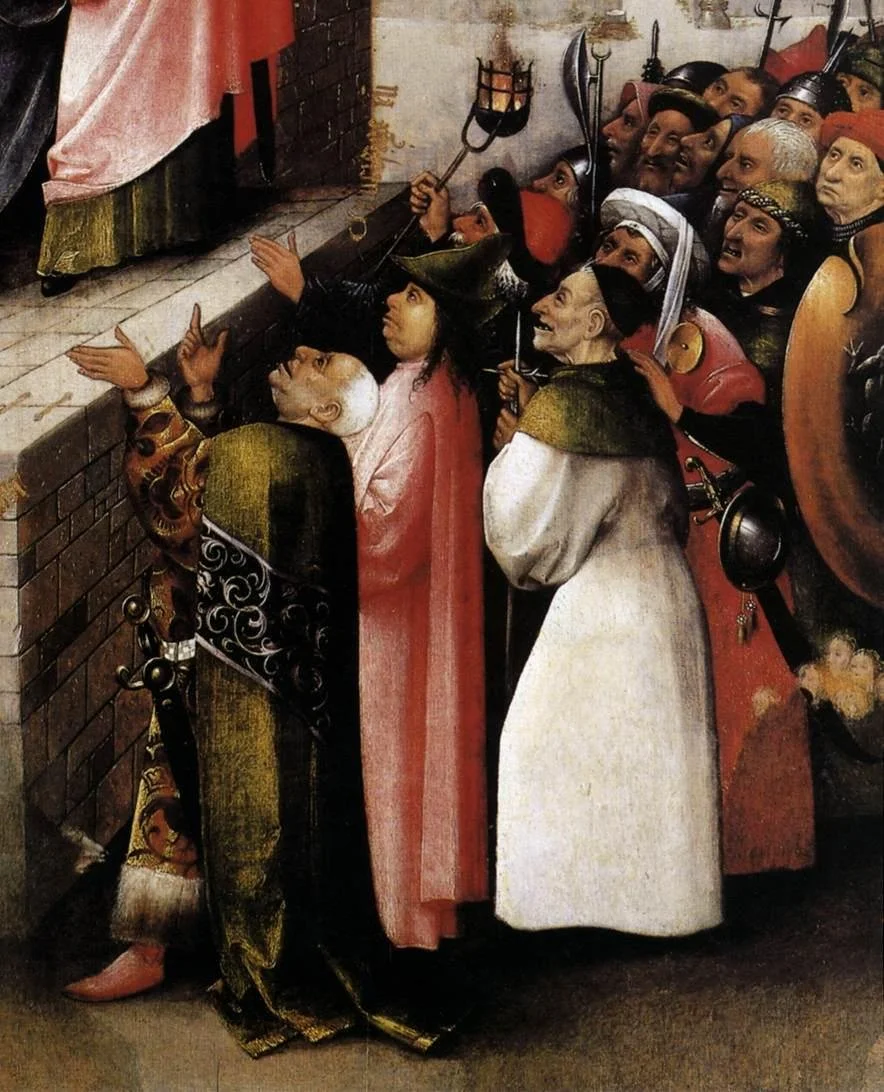
Detail from Ecce Homo: Bosch gives each member of the crowd a distinct expression, transforming an anonymous mob into individuals who each make their own moral choice.
Bosch's Emerging Style
Although this painting predates Bosch's famous monsters, several characteristics already define his work.
First, he demonstrates an extraordinary ability to portray human psychology. Every face tells a different story.
Second, Bosch fills the composition with meaningful details that reward careful observation.
Finally, rather than depicting a distant biblical event, he asks viewers to see themselves within the story.
This moral engagement would later become one of the defining features of masterpieces such as The Haywain, The Temptation of St. Anthony, and The Garden of Earthly Delights.
Europe Around 1480
When Bosch painted Ecce Homo, Europe was entering a period of dramatic transformation.
The Renaissance was flourishing in Italy, where artists such as Leonardo da Vinci, Sandro Botticelli, and Andrea del Verrocchio were revolutionizing painting through perspective, anatomy, and natural observation.
Meanwhile, Northern Europe followed a different path.
Artists such as Jan van Eyck, Rogier van der Weyden, and Hans Memling emphasized painstaking realism, luminous oil painting, and symbolic detail. Bosch inherited this northern tradition while gradually pushing it into entirely new territory.
The Duchy of Brabant, where Bosch lived in the prosperous city of 's-Hertogenbosch, enjoyed relative stability under the Burgundian and later Habsburg rulers. Expanding trade brought wealth, while the Church remained the dominant influence on daily life.
Yet beneath this prosperity lay widespread anxiety.
Recurring outbreaks of plague, political uncertainty, and constant reminders of mortality shaped medieval society. Public sermons warned of the Last Judgment, while devotional movements encouraged believers to examine their own consciences.
Bosch absorbed these concerns deeply. Even in Ecce Homo, painted before his more fantastical works, the central question is not political but moral:
What kind of person are you when confronted with truth?
A Turning Point in Northern Art
At first glance, Ecce Homo appears almost conventional compared with Bosch's later paintings.
Look closer, however, and the seeds of his future genius become visible.
Rather than dazzling viewers with spectacle, Bosch creates tension through subtle expressions, carefully observed gestures, and the uncomfortable realization that the hostile crowd looks remarkably ordinary.
His monsters would come later.
First, Bosch wanted us to recognize that humanity itself could be frightening enough.
Why Ecce Homo Matters Today
More than five centuries after it was painted, Ecce Homo remains remarkably relevant.
The painting reminds us that injustice often depends less on a single villain than on the willingness of ordinary people to follow the crowd. Bosch's message transcends its biblical setting, asking viewers in every age to examine their own compassion, courage, and moral judgment.
It may lack the strange beasts and dreamlike landscapes that made Bosch famous, but Ecce Homo reveals the young artist discovering the themes that would define his entire career: human choice, moral responsibility, and the eternal struggle between conscience and conformity.
For anyone exploring Bosch's artistic journey, this quiet early masterpiece is the ideal place to begin.